Posts

MOUNTAIN OF REVELATION, MOUNTAIN OF FAITHFULNESS.
Image
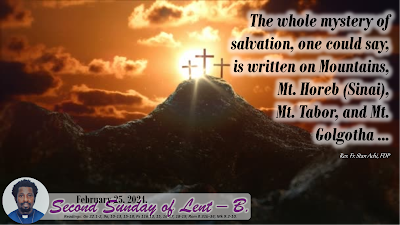
February 25, 2024. Second Sunday of Lent – B. Readings: Gn 22:1-2, 9a, 10-13, 15-18; Ps 116:10, 15, 16-17,18-19; Rom 8:31b-34; Mk 9:2-10. “Jesus took Peter, James, and John and led them up a high mountain apart by themselves.” Mk 9:2 A Chinese proverb says: “You must climb the mountain if you would see the plain.” An Ivorian proverb adds: “If a frog leaves the swamp for the mountains, it means it is in danger.” We are today, the second week of our forty days' pilgrimage, and the liturgy emphasizes the reality of faith. We are urged to make room for faithfulness to God through listening to his voice and obeying his commandments. And beautiful, all these calls for faithfulness happen on the top of Mountains because the high places, the mountains stand as places of encounter with the Lord. After that of the desert last Sunday as a place of intimacy, prayer, and faithfulness, we are taken today to another place of encounter, the mountains. It is said that Mountains have a l...
DESERT, TEMPTATIONS, FAITHFULNESS TO THE COVENANT OF LOVE, AND FREEDOM.

Image
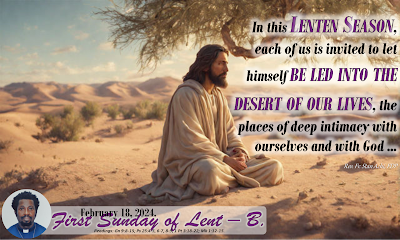
February 18, 2024. First Sunday of Lent – B. Readings: Gn 9:8-15; Ps 25:4-5, 6-7, 8-9; 1 Pt 3:18-22; Mk1:12-15. “The Spirit drove Jesus out into the desert, and he remained in the desert for forty days, tempted by Satan.” (Mk 1:12) An Arabic proverb says: “In the desert of life the wise person travels by caravan, while the fool prefers to travel alone.” A Bambara proverb adds: “The greatest crime in a desert is to find water and keep silent about it.” In each one's life, there are moments when we are put to the test. We are tempted, sometimes, even beyond our capacity for resistance. All the temptations we go through are a test of our ability to keep faithful to our promises and covenants. No one is exempted from temptations. Even Jesus, the Messiah, the Son of God, was not exempt from temptation. The capacity to resist and keep faithfulness in front of temptations is what determines our love. He who truly loves, endures, and resists. Besides, without temptation, we canno...

ASHES OF HUMILITY, CONVERSION, AND LOVE.

Image
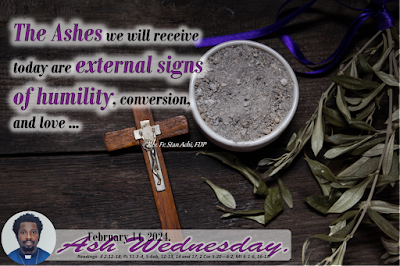
February 14, 2024. Ash Wednesday. Readings: Jl 2:12-18; Ps 51:3-4, 5-6ab, 12-13, 14 and 17; 2Cor 5:20—6:2; Mt 6:1-6, 16-18. “If today you hear his voice, harden not your hearts.” Ps 95:8 A Sicilian proverb says: “Asparagus and mushrooms teach a cook humility.” A British proverb adds: “The measure of our sacrifice is the measure of our love.” While some people are celebrating and singing Valentines, the erotic and commercial dimension of love today, February 14th, we are brought, as an effect of coincidence, to celebrate today the beginning of Lent. Maybe a twist of fate, but it is a beautiful coincidence that Lent is also a call to value the sacrificial love that is nourished through prayer, lived in fasting, and expressed in almsgiving. We enter today, a season of love and sacrifice that will find its culmination in the supreme sacrifice, on the day of the “Consumatum est”, on Good Friday. The Ashes we will receive today are external signs of humility, conversion, and love. ...

GOD OF THE OUTCASTS.

Image
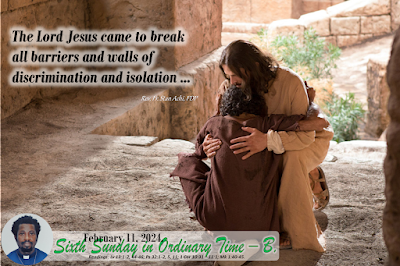
February 11, 2024. Sixth Sunday in Ordinary Time – B. Readings: Lv 13:1-2, 44-46; Ps 32:1-2, 5, 11; 1 Cor 10:31—11:1;Mk 1:40-45.  “If you wish, you can make me clean. Moved with pity, he stretched out his hand, touched him, and said to him, I do will it. Be made clean.” Mk 1:40 An Amerindian proverb says: “The moon doth not withhold the light, even from the cottage of a Chandala (outcast).” An Irish proverb adds: “There is no pain greater than the pain of rejection.” "Is not man’s life on earth a drudgery?" That was Job's interrogation that opened us to last Sunday's meditation on the word of God. But we realized with great faith and hope and rooted in prayer that, no matter the sufferings and hardships man goes through, the Lord is never far away from us. He never forsakes us. "The Lord hears the cry of the poor," would echo the Psalmist with Ps 34. When, in our tragedies or dramatic situations of life, we call to him in prayer, the Lord always hear...

GOD IN THE DRAMAS OF HUMANITY.

Image
February 4, 2024. Fifth Sunday in Ordinary Time – B. Readings: Jb 7:1-4, 6-7; Ps 147:1-2, 3-4, 5-6; 1 Cor9:16-19, 22-23; Mk 1:29-39. “Simon's mother-in-law lay sick with a fever. They immediately told him about her. He approached, grasped her hand, and helped her up…” Mk 1:30 A Haitian proverb says: “True courage is knowing how to suffer.” An Akan proverb adds: “To suffer doesn't mean to die.” Life is not without dramatic situations and happenings. From times, when we look at all the events that surround human life and the dramatic experiences some people go through, we are tempted to ask, why? Why does God allow such suffering? Where is he when mankind suffers? Human suffering is a perpetual question of faith and to God. Professor Douglas John Hall wrote a beautiful essay with an amazing title, "God & Human Suffering, an exercise in the theology of the Cross." The title itself puts a question and leads to an answer. When we suffer, God is never away f...

THE WORD OF GOD.

Image
January 28, 2024. Fourth Sunday in Ordinary Time - B. Readings: Dt 18:15-20; Ps 95:1-2, 6-7, 7-9; 1 Cor 7:32-35; Mk1:21-28. “I will raise up for them a prophet like you from among their kin, and will put my words into his mouth; he shall tell them all that I command him.” Deuteronomy 18:18 A Native American proverb says: “The words of God are not like the oak leaf which dies and falls to the earth, but like the pine tree which stays green forever.” A Moroccan proverb adds: “One who is not moved by words is not moved by the stick.” The word of God has the power to convict us of sin, to teach us truth, and to lead us in righteousness (Psalm 119:9-11). It is living and active. It is before all things, and through it, everything came into being. The world and all it contains are fruits of the Word of God. The Evangelist John, in his prologue to his Gospel, says it right: "In the beginning was the Word... Through him, all things came into being, not one thing came into bein...

CHILD, AND YET, A SAVIOR.

Image
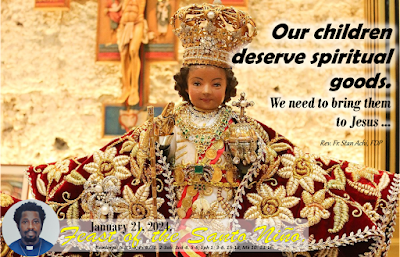
January 21, 2024. Feast of the Santo Niño, Holy Childhood Day (Sancta Infantia). Week of Prayer for Christian Unity. Readings: Is 9:1-6; Ps 97: 1. 2-3ab. 3cd-4. 5-6; Eph 1: 3-6.15-18; Mk 10: 13-16. “Let the children come to me; do not prevent them, for the kingdom of God belongs to such as these.” Mk 10:14 A Swedish proverb says: “From children old people arise.” A Burmese proverb adds: “Parents are the first teachers of the children.” We are celebrating today a feast that for every Filipino has a great meaning and conveys a great message. The Santo Niño, or Holy Infant, while plunging us back to the joy of Christmas, bears a message of love and hope. It speaks of the love of God for our humanity and brings us hope that, despite all trials, sufferings, humiliating situations, poverty, and rejection, God will always be by our side. The feast of the Holy Infant or Santo Niño is about our faith in God who gives us His Only Begotten Son, the little boy of Bethlehem, the Son of ...