Posts

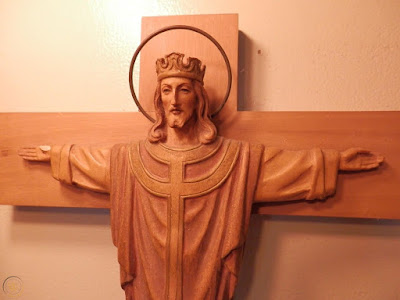
The Revolution of Kingship, or when the king dies out of love to save his subjects.
Image
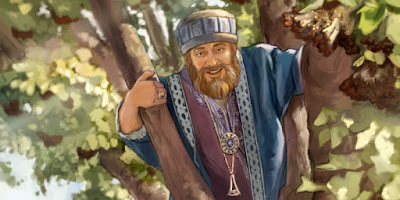
November 24 2019: The Solemnity of Our Lord Jesus Christ, King of the Universe READINGS:  2 Sm 5:1-3 ;  Ps 122:1-2, 3-4, 4-5; Col 1:12-20 ;  Lk 23:35-43     A Wolof proverb says, “To love the king is not bad, but a king who loves you is better.” It will sound surprising, but the first chapters of the New Testament (the Gospels) referring to Jesus birth introduce him as king (Luke 1:32-33). The last chapters talking of his death speak of his kingship (John 19:19). He was born king, he died king. That is what we celebrate today. There is a soon to come American fiction movie, “The King’s Man”, which gives a beautiful definition of power and nobility. It says, “real power is not found running after war. But real power lies in understanding who it is you are truly fighting, and how they can be defeated.” We all dream of kingship, noble life, power and position of authority; and to reach the fulfilment of that dream, we will easily do anyth...

The future is in the present: the “already and not yet” of the Kingdom.

Image
November 17 2019: Thirty-third Sunday in Ordinary Time - C READINGS:  Mal 3:19-20a ;  Ps 98:5-6, 7-8, 9 ;  2 Thes 3:7-12 ;  Lk 21:5-19 A Chinese proverb says, “All the past died yesterday; the future is born today.” The Kingdom of God is a coming reality. Yet, it manifests itself in the present. The Theologians speak of the already and not yet of God’s kingdom. That concept of “already but not yet” holds that believers are actively taking part in the kingdom of God, although the kingdom will not reach its full expression until sometime in the future. We are “already” in the kingdom, but we do “not yet” see it in its glory. Christians are people of dual citizenship. While fully living on earth, we have the obligation to contribute in building the Kingdom of God. We say it clearly in the Lord’s Prayer: “Your kingdom come, Your will be done, on earth as it is in heaven” (Mt 6;10). Our longing for heaven does, however, not disconnect us from thi...

House of God.

Image
November 9 2019: Feast of the Dedication of the Lateran Basilica in Rome   READINGS:  Ez 47:1-2, 8-9, 12 ;  Ps 46:2-3, 5-6, 8-9 ;  1 Cor 3:9c-11, 16-17 ;  Jn 2:13-22 A British proverb says, “Burn not your house to fright the mouse away.” Another proverb adds, “A house that is not seen by the sun, is visited often by the doctor.” “Behold God’s dwelling with the human race. He will dwell with them and they will be his people, and God himself with them will be their God.” This opening antiphon of our eucharistic celebration gives the true meaning of what we are feasting on today. We are commemorating with great joy the dedication of the Lateran Basilica, the Cathedral of the Pope as Bishop of Rome. This church is also called the “Mother of all churches”. Beyond the stony and architectural building of the Lateran constructed by the Emperor Constantin, back the years 320, what we are celebrating is a God choosing to make his dwelling in the midst...

“I believe in the resurrection of the body.”

Image
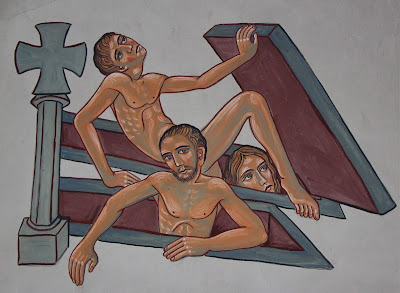
November 10 2019: Thirty-second Sunday in Ordinary Time - C   READINGS:   2 Mc 7:1-2, 9-14 ;  Ps 17:1, 5-6, 8, 15 ;  2 Thes 2:16-3:5 ;  Lk 20:27-38  An Arabic proverb says, “A horse which is tamed at forty is only good for resurrection day.” “I believe in the resurrection of the body,” proclaims Catholics in the Creed. An act of faith that raises many misunderstandings. It is in fact what distinguishes Christianity and especially Catholicism from many other religions. By our belief in the resurrection, we profess that to die with Christ is to live. The Catechism of the Catholic Church states, “Because of Christ, Christian death has a positive meaning: "For to me to live is Christ, and to die is gain" (Phil 1:21.) "The saying is sure: if we have died with him, we will also live with him (2 Tim 2:11). What is essentially new about Christian death is this: through Baptism, the Christian has already "died with Christ" sacramentally, in ord...

Boundless love expressed in mercy.

Image
November 3 2019: Thirty-first Sunday in Ordinary Time - C   READINGS:  Wis 11:22-12:2 ;  Ps 145:1-2, 8-9, 10-11, 13, 14 ;  2 Thes 1:11-2:2 ;  Lk 19:1-10 A Moroccan proverb says, “The donkey has limited abilities, but its love for carrot is boundless.” The Lord’s mercy knows no limit. It is opened to all, righteous as well as sinners. Those who experience that merciful love can in return not contain it for themselves. They are pushed to give it out to others. It happens times that my reflection goes to the deep meaning of the name of Jesus, “God saves”. Then comes to me a question on salvation: Does God make any selection or segregation in redeeming? Today’s liturgy comes to provide an answer. God makes no distinction, no classification, neither discrimination or segregation in his redemptive mission. From the book of Genesis, we read that he created all things good and out of love. Sin, however, through the evil one brought corruption into th...

The living must pray for the dead: an act of faith in the resurrection.

Image
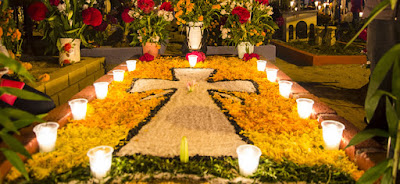
November 2 2019: The Commemoration of All the Faithful Departed (All Souls)   READINGS:  Wis 3:1-9 ;  Ps 23:1-3a, 3b-4, 5, 6 ;  Rom 5:5-11 ;  Jn 6:37-40 A Bantu Proverb says, “A dead man does not know where his grave is.” It is up to the living to bury and to pray for the dead. A Senegalese writer, Birago Diop, in his work ‘The Breath of the Ancestors’ wrote, “Those who died never left. They are in the shadow that lights up and in the shadow that thickens. The dead are not under the ground. They are in the trembling tree, they are in the groaning wood, they are in the flowing water, they are in the hut, they are in the crowd. The dead are not dead.” Why do we pray for the dead? Far from being an act of idolatry or a necromantic rehearsal, it is an act of faith, to pray for the dead. It is the expression of our faith in the resurrection. We pray for the dead to demystify death. The Psalm 115:17-18 sings, “The dead do not praise the Lord, no...

The holiness challenge.

Image
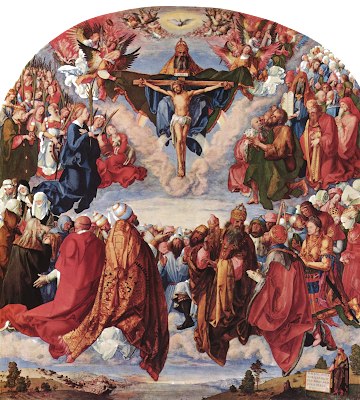
  November 1 2019: Solemnity of All Saints   READINGS:  Rv 7:2-4, 9-14 ;  Ps 24:1bc-2, 3-4ab, 5-6 ;  1 Jn 3:1-3 ;  Mt 5:1-12a An American proverb says, “It is a man's challenge to go as far as he can on the right road.” Life is made of challenges. Christian life the more, is a challenge to holiness. God created us “very good” (Gn 1:31), and we are called to perfection. Our vocation, the finality of our existence is to be in the Glory of God, that is to live and be with God. St. Augustine could therefore affirm in his Confessions, “You have made us for Yourself, and our hearts are restless until they rest in You.” We are actually created to be in God. The Catechism of the Catholic Church in its article 2013 states, “All Christians in any state or walk of life are called to the fullness of Christian life and to the perfection of charity." All are called to holiness: "Be perfect, as your heavenly Father is perfect."” Then, it carr...